 Another one just came across my desk: a kitchen where the plans call for lighting placed precisely in the wrong place. Chopping with large knives and dealing with hot pans is no place for poor lighting and obscuring shadows, and this is just one reason kitchens have the most at stake when it comes to lighting. If you put lighting in the wrong place in your kitchen, it will also be very, very expensive to fix.
Which means you may save a few band-aids and a few dollars if you get it right the first time.
Twenty years into my lighting career, I still believe that lighting design is not rocket science. But it does help to have some experience and to slow down and think things through. Unfortunately, of the hundreds of thousands of new homes built each year in the United States, that does not seem to happen very often.
How else to you explain the all-too-common kitchen lighting plan that calls for better lighting on the floors than the countertops?
I realize not everyone is going to click on lightcanhelpyou.com and hire me to design lighting for their new home. If you’re on your own, use this guide to help lay out your kitchen lighting plan, and protect your fingers while you make the space more livable.
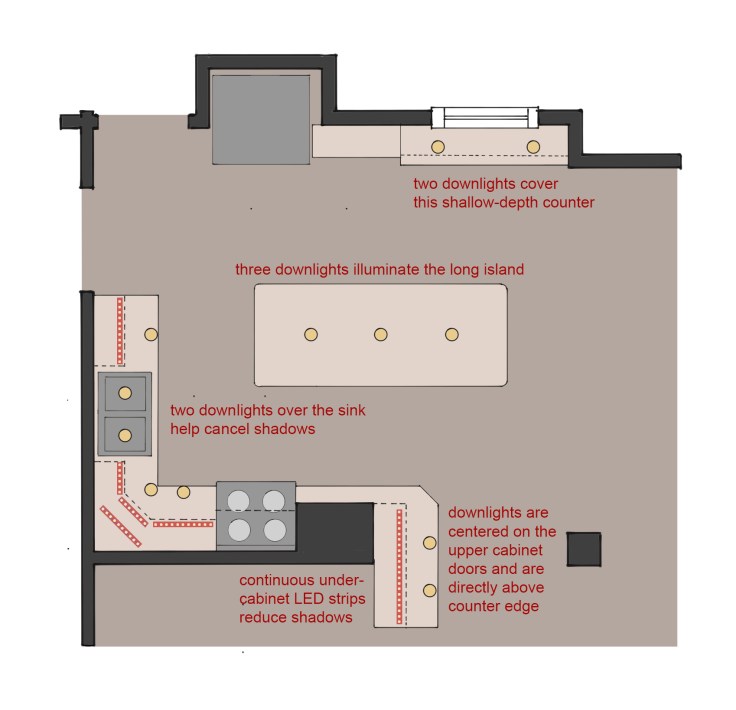
Step One: Light the Counters
This one should be a no-brainer, but it is amazing how often this gets left to chance. Instead of using a few very large, very bright recessed downlights, I recommend using more smaller fixtures. The overlapping beams of light will help better light the counter by canceling shadows, and the smaller opening can mean less glare. Avoid the shallow “disk” style lights that are popular now; they will light the cabinets well but leave the counters lacking.
We spend a lot of time at the sink, and the shadows from a single downlight can be quite off-putting. Three small downlights do a much better job and make the space more pleasant as well.
I recommend LED under-cabinet lighting for nearly every project to help reduce shadows and make it easier to avoid fingers while chopping vegetables. It’s easy to get another carrot, but not so easy to get another finger.
For more on under-cabinet lighting, read this post.

Step Two: Light Appliances, Pantries, & Upper Cabinets
Appliance lighting is getting better and better, but it is still possible to buy a range hood or wall-mounted microwave with entirely inadequate lighting. Don’t pass over this area when laying out downlights, and look for hoods with strong light. The equivalent of two 50-watt halogen PAR20 bulbs is great for a 30″ range; add more if your cooktop is larger.
Recessed downlights in front of pantries, if carefully placed, can put light on the items stored inside. The same fixture may give a nice wash of light to the front of the cabinet, which is especially beneficial on wood cabinets. The fridge is just like another pantry, and the downlight above will be much cheaper to install now than later.
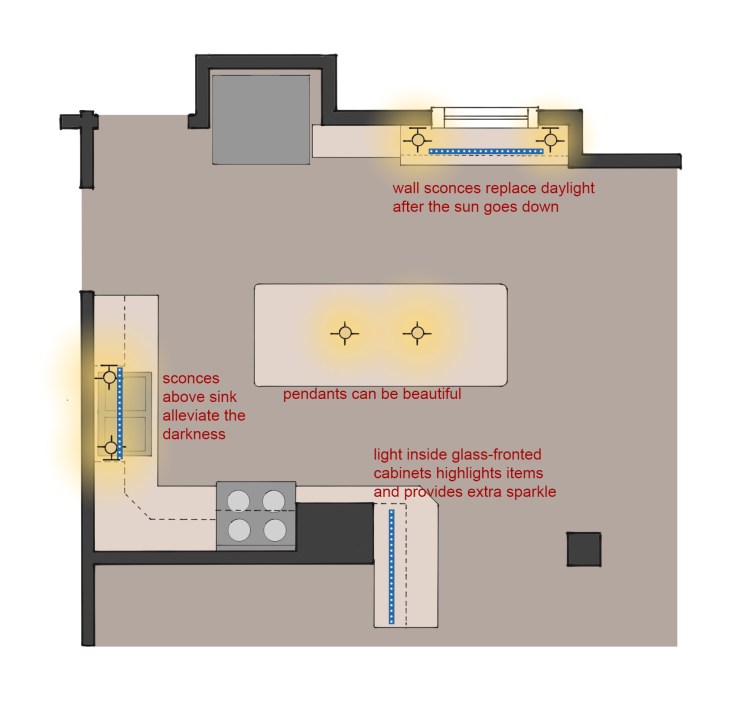
Step Three: Make it Feel Better
Why do restaurants put in fireplaces? To make you feel comfortable. When you cannot put a fireplace in the kitchen (hey, that’s an idea!), add in light that makes you feel more comfortable. Wall sconces, pendants, and illuminated cabinets can all make a
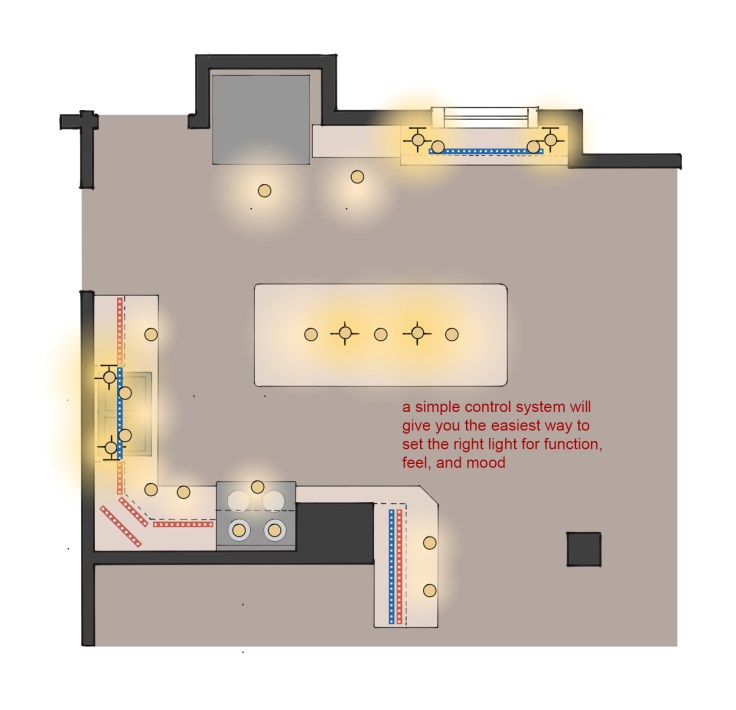
Step Four: Take Control
The plan above is complete- almost. With this many lights, it helps to be able to easily turn them on and off. A simple control system will give you a few presets (like on, off, entertain, and snack) that make it easy for you to set and memorize the settings that work best. While this will add a little extra cost up front, you’ll use it every day for as long as you own the home.

Step Five: Light the Floor
Okay, now that we’ve covered the essentials, we can light the floor. Wait…is that necessary? Usually not. The kitchen above has plenty of light on the floor, the spill and glow from other lights being more than enough for walking, cleaning, and admiring the wood. If you still want to light the floor, put light underneath the toe kicks. Besides looking cool, toe kick light works as a great nightlight.
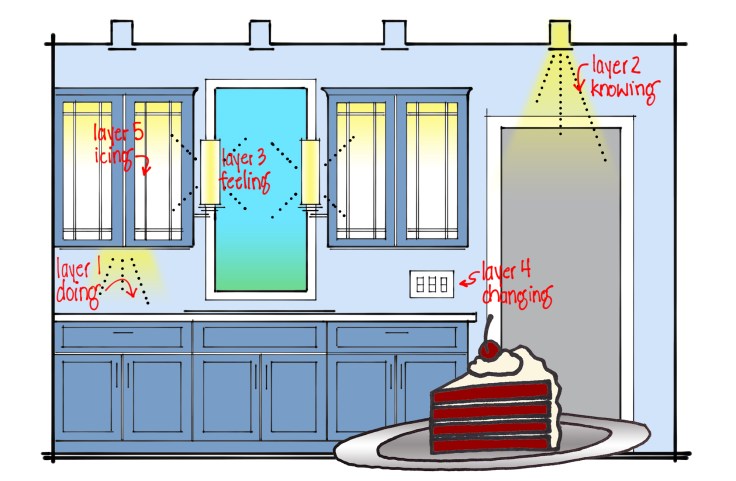
That’s it. Check out the kitchen tag for more related advice on getting more out of your kitchen.
 the language of light
Very helpful!Sent from my Verizon, Samsung Galaxy smartphone
LikeLike
I’m curious how far each recessed light should be spaced? 4” ones
LikeLike
Christina, that will depend on the ceiling height, lumen output, and beam angle. Over a typical kitchen counter, I’ll space an average downlight 18-24” apart.
LikeLike
Hi David. Thanks, wow, much closer than I realized! The lights we are looking at are 950 lumens and 94 degrees wide flood (is that the beam angle?)
They are 4” recessed
https://www.prolighting.com/nlth-41tw-mpw.html
Unless you have a better suggestion? It’s a small kitchen and I think we have a good idea of placement thanks to your blogs (24-25” from the wall/12” from cabinet, centered on cabinets but didn’t know how many we needed in general due to spacing from each other).
LikeLike
Christina, you could space those as much as 3′ apart, or whatever makes sense in alignment with the upper cabinets. There are better fixtures on that website, but they do go up in cost. The link below is to a fixture that requires the purchase of a module, trim, and housing, so quite a bit more, but comes with better regress and warm-dim, a very nice feature usually found in fixtures costing much more. https://www.prolighting.com/brands/dmf-lighting/dmf-lighting-h-series-led-downlights/hm3c.html
LikeLike
Thank you 🙂 I’ll take a look. I’ve looked at DMF but got confused on what parts were needed. Thanks again! Oh, for the ones you linked how far apart would you suggest spacing for 4”?
LikeLike
Christina, the same spacing, let’s call it 18”-36”, depending on cabinetry alignment.
>
LikeLike
Thanks so much 🙂
LikeLike
It’s a standard height ceiling
LikeLike
This was extremely helpful.
If I have a much higher ceiling with no upper cabinets, should I look at getting recessed lights with a more focused beam?
LikeLike
That’s exactly right, Josh. Another technique we use regularly is to put wall sconces above the countertop/windows to get the light source closer to the counter. If you go that route, look for sconces that hide the bulb and direct light downwards.
LikeLike
This is sort what I have planned so far, do you see any issues? I would happily pay for more personalized advice if you offer that sort of thing.
3D View
Elec Plan
LikeLike
Josh, this looks pretty good! I have a few comments https://www.dropbox.com/scl/fi/2xs4j7kqun5eh1wvimx9r/LOL-Josh.pdf?rlkey=gzvjv7gbv3az5w2ytcaq0kg1f&dl=0. If you would like more detailed design and specification, check us out at lightcanhelpyou.com.
LikeLike
Do the red arrows coming out of the lights have any significance?
LikeLike
Yes! The arrows indicate aiming direction. I usually recommend utilizing recessed adjustable downlights that tilt a few degrees towards the cabinets.
LikeLike
Thanks, after laying them out, most of them line up directly with roof joists, which rules out recessed lighting. I don’t love the idea of pendant lights, but since it’s already a higher ceiling (11′) maybe they would be alright? Are there any other alternatives? (I can’t drop the ceiling at all because of an exposed structural beam)
LikeLike
Sorry to hear that! Solutions include installing a false ceiling, using pendants with downward facing illumination, using monopoints (essentially solo track heads), and track light. There are other ways, but it gets complicated. And sometimes we double lights on each side of a joist. Or move the joist…
LikeLike
Monopoints look more like something I’d like. thanks so much
LikeLike
Hey David, love the content. With regards to a somewhat large rectangular island (9′ x 5′) – do you think it would work to place 4 recessed adjustable downlights (VC Entra dim-to-warm – already purchased) at the corners of the countertop and slightly angle them back in towards the center? There will also be a sink with 2 dedicated downlights over it (so 6 total downlights for this island – separately controlled). I can’t find any pendants I like, but I plan to have the wiring in place for 2 future pendants.
LikeLike
Sophia, thanks for the question. Yes, I think your proposed solution will work reasonably well. If there is room to “scoot” the lights in towards the center of the island about 6″, you may be able to angle them slightly less. Less tilt/angle means they will be less likely to shine into someone’s eyes. Good luck!
LikeLike
Thanks for the article. Our ceilings are sloped and we plan to use sloped recessed. Our ceilings are 10ft and the cabinets will go to 9ft. I plan to place the perimeter recessed along the edge of the counter as mentioned. But I am not sure about recessed placement for the pantry and fridge other than to center them. How far from the fridge (32″ from wall”) and pantry (24″standard depth”) would you recommend to place these? Similar question for the hood fan, we are building a custom cabinet to match the kitchen cabinets and this will be 21″ deep and 42″ wide. it has lights underneath. Should I place the recessed at the edge of the stove or is there a recommended spacing from the fan cabinet?
LikeLike
Nicolene, great question. The answer is a bit of geometry. Create an imaginary line at about eye height or just above, then another imaginary line between eye height on the face of the upper cabinet and the center of the recessed light over the counter edge. That second line is the angle the recessed light will “strike” the face of the cabinet, and generally I try to match that angle for refrigerators, pantries, wall ovens, etc. So I just move that imaginary line out to the face of the pantry and see where it points on the ceiling. Hope that helps!
LikeLike