The Simple Gift of Light #10
There is a part of me that wants lighting design to be so complicated, technical, and artistic that no one else tries it, leaving all of the opportunities to me. In this fantasy world- the one where lighting is too complex for ordinary citizens to grasp- I get to grow my business to epic proportions and rule the universe. Fortunately, there is another part of me that believes otherwise.
Light, despite being one of the most intriguing elements of the universe, is simply not that difficult to get right in our homes. So why do I argue that most of us live with awful lighting? Not because it is too complicated or too expensive, but because it takes thought.
So if I am correct and getting better lighting just takes a little thought, why don’t people think about it? That’s easy- we have enough to think about already. As I write this I have a task list at work a mile long, taxes to prepare and dishes to wash tonight, a dozen projects around the house that need tackling, and a world full of news that rocks the boat on a regular basis. In other words, who has time to think about lighting?
Today’s focus on the Work Zone is a perfect case and point. Lighting for the work we do is quite simple: we need strong, focused, shadow-free light where our hands go, ideally from below our eye level to shield us from glare.
That’s it, blog post is done, now let’s move on.
You know me better than that. Let’s go deeper.
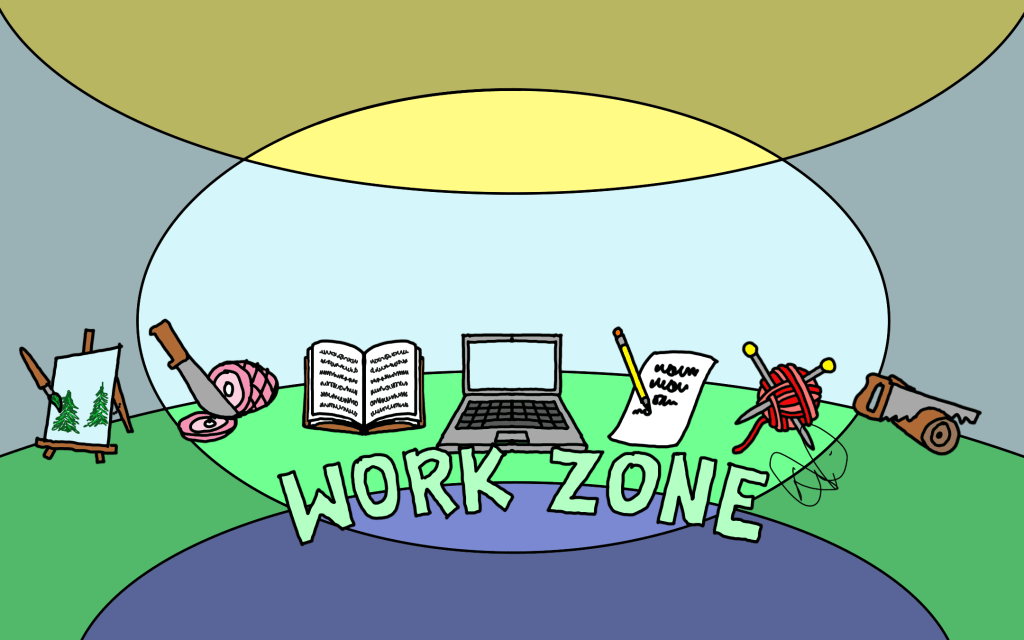
The Work Zone is one of four lighting zones I created to organize my thoughts and make design easier to understand. Typically sandwiched between the Comfort Zone at eye level and the Safety Zone down by our feet, the Work Zone is usually where our hands do things. Sure, sometimes the things our hands do are fun, like playing board games, but even that can be called work if you are a blogger going for simple.
Light in the Work Zone could therefore be called light for our hands. For knitting. For chopping vegetables. For reading, writing, typing, crafting, building, cleaning, and packing a suitcase. Because humans often do work with their hands, the best light in the Work Zone tends to be around waist level. Think tables, desks, countertops, and our laps. And because our eyes do not like bright light- but our Work Zone is best when brightly lit- it just makes sense to place the light below our eye level and to shield it from view.
See what I mean? Not that hard. But oh my, do we get this one wrong all the time.
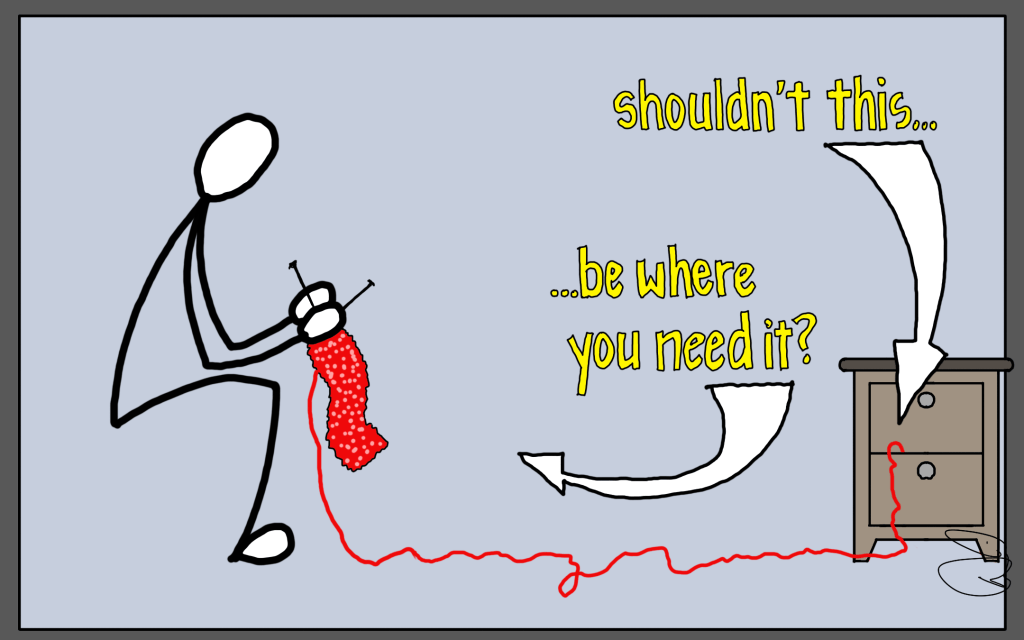
Instead of placing light in the Work Zone, we often place light somewhere else and hope that it works for everything and everyone, every time. But shouldn’t light be where we need it?
When knitting, at least as far as I understand it, you might want your basket of yarn nearby. Would you put your ball of yarn in a desk drawer across the room from your couch, and leave it there even when you are working? I doubt it. So why is your light over there?
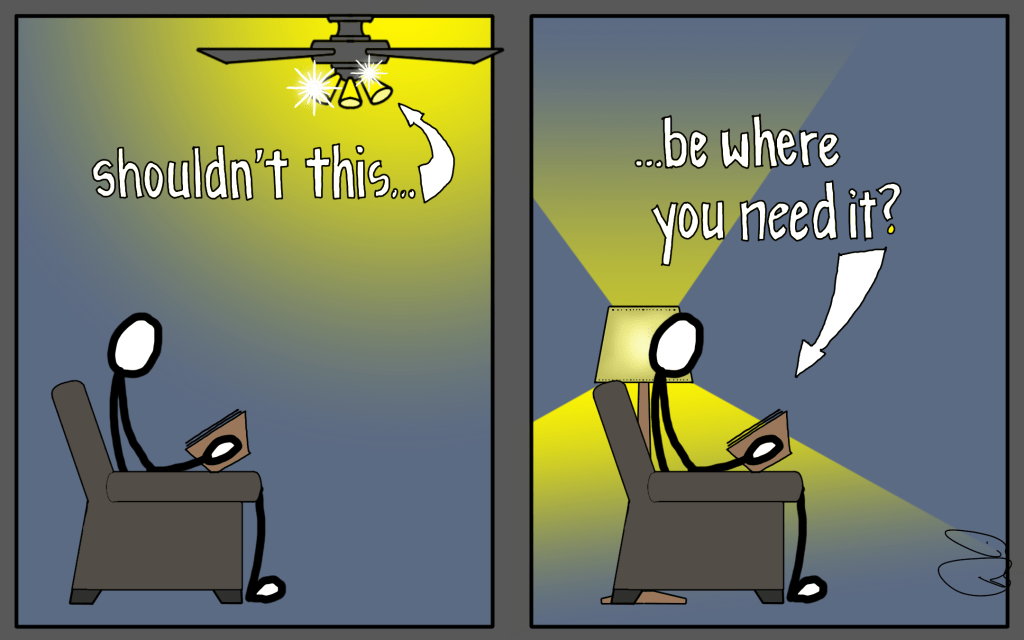
Most lighting in our homes, save a few lamps, comes from above our heads. This is easy to install but, when considering ideal light in the Work Zone, just does not make sense.
Imagine for a moment that you are reading a real paper book in the living room in the afternoon. The sun sets and evening falls so you turn on the overhead “big light.” In this case it is a ceiling fan with light kit, but it could be wafer lights, a chandelier, or just about any other bright overhead light. Now you have plenty of light on your book, but it is coming from the wrong place.
The result is glare in your eyes, which subconsciously reduces your level of comfort and may even cause eyestrain and fatigue. You decide to stop reading because you developed a headache. Funny how your headache waiting until the overhead lighting to present.
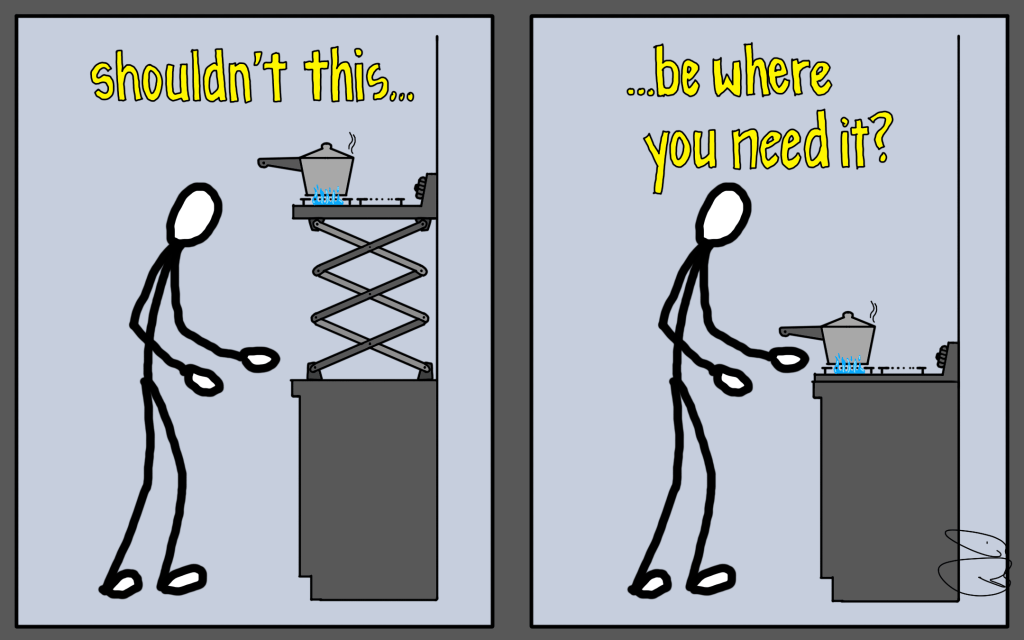
As you may have noticed, I had a little fun with this one. Once you ask the question “what work do we do in the house – and what if it was in the wrong place?” it is easy to start generating ideas. If I had an editor (or more writing skills), I would omit some of these. Too bad this is a blog and no one is stopping me….
Ready to upgrade your kitchen appliances? Buy our new Out-of-Range adjustable cooktop that automatically raises to 88” whenever you cook to keep the flames away from children’s vulnerable fingers.
This even kind of makes sense – the higher the cooktop, the safer it might be for children. There is just one small problem – it puts the cooktop in the wrong place for your work. Shouldn’t the cooktop be where you need it, where your hands are?
If my deluxe Out-of-Range feels ridiculous to you, why does relying on overhead lighting feel okay?
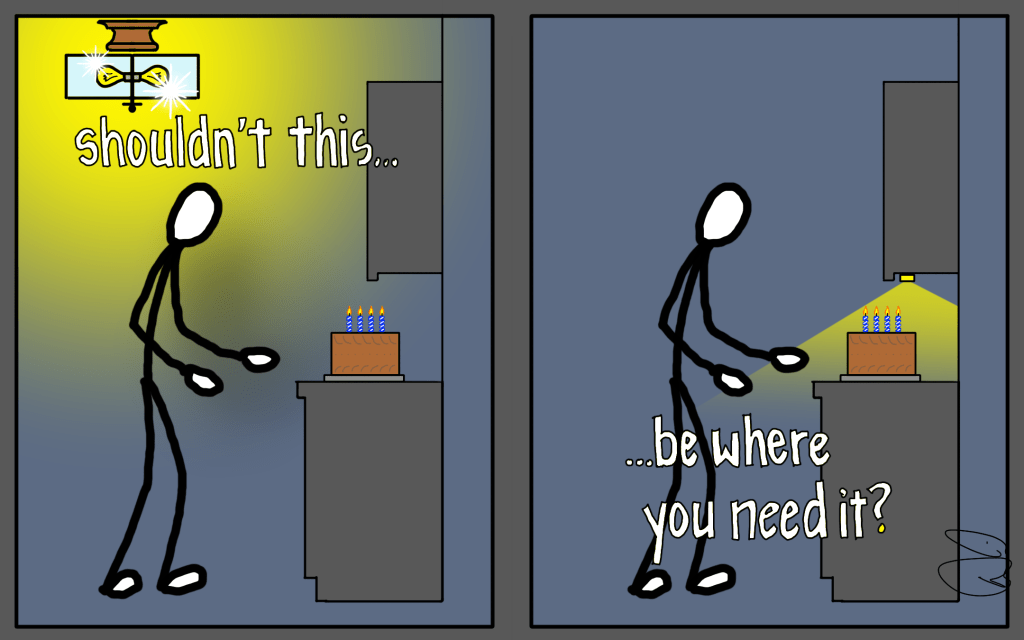
The solutions vary, but in the kitchen the most obvious is under-cabinet lighting for counters. Overhead lights are so often located above the walkways, behind us, in effect raising the well-lit area above our heads just like the Out-of-Range pushes the cooktop above our heads.
Light below the cabinets, directed towards the countertop itself, provides better light where we need it without causing glare in our eyes. And, when we use modern lensed linear LED fixtures, shadows can all but disappear.
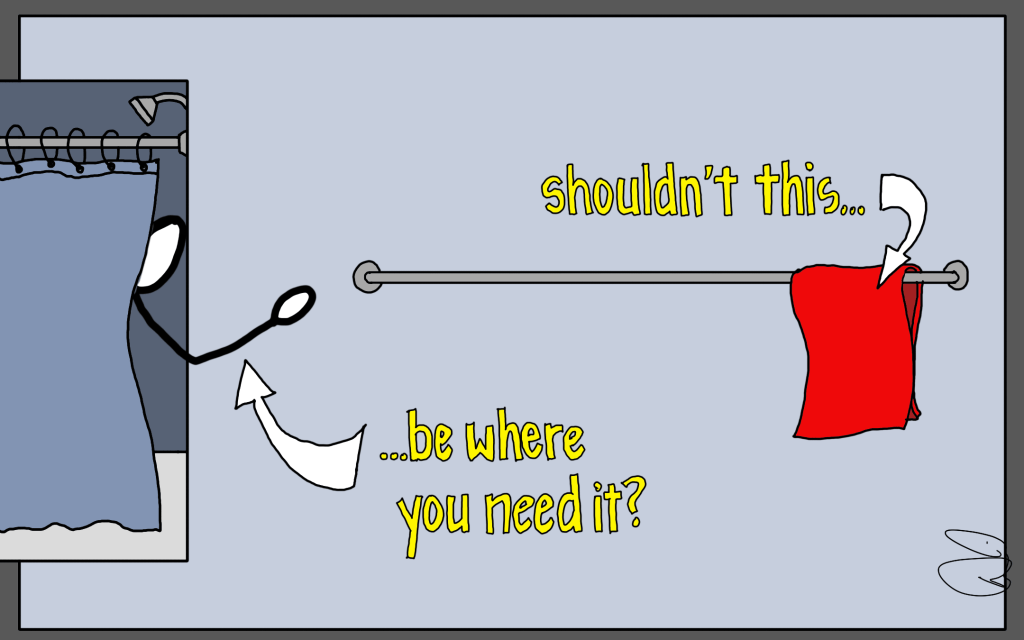
I travel a bit for work, which means I see the inside of a good number of hotel room bathrooms. Most of the time there is a robe hook or towel bar within reach of the tub. It just makes sense – put the towels where you are most likely to need them.
Every now and then I end up showering in a bathroom without such a convenience. Why put the towels where they cannot be reached when you are dripping wet?
Why put light for our Work Zone in the Glare Zone?
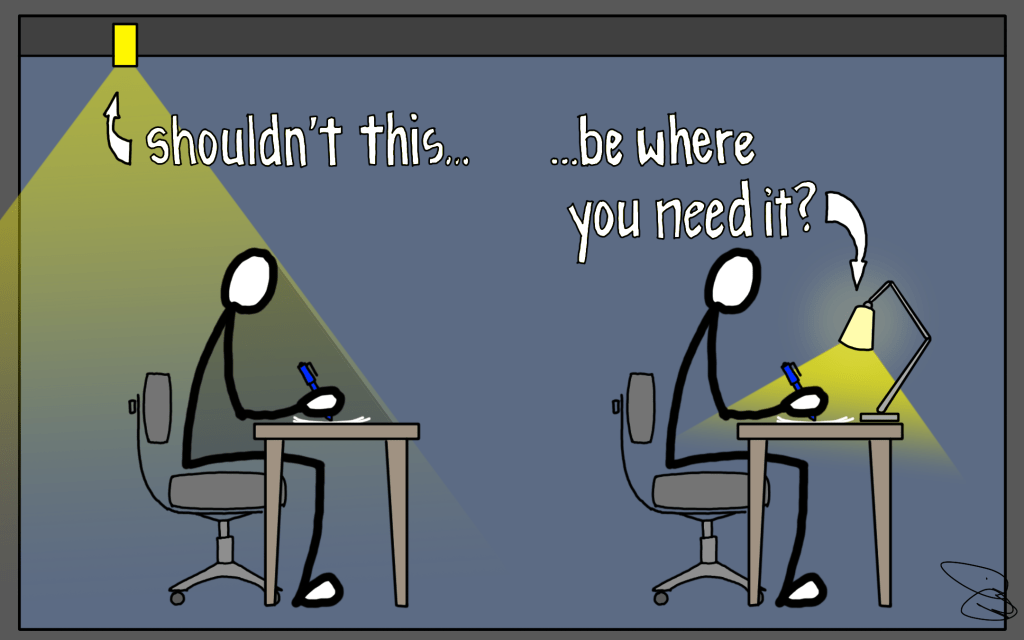
Lighting in the Work Zone can sometimes be solved by what is commonly known as “task lighting.” Task lighting is a somewhat vague term that can be applied to many kinds of light fixtures, but the idea is a good one: put the light where you need it.
On a desk, a task light is a lamp that pushes strong light to the desk’s surface without shining in your eyes.
By a chair, a task light might be a lamp with a soft shade that directs strong light to your book.
In a woodshop, a task light might be a linear LED strip embedded in a horizontal piece of trim about 18” above the workbench…say, what? Confused? That is because, instead of buying a something labeled “work light” or “workshop task light,” I asked myself “how could I get good, strong, shadow-free light onto a workbench without overhead glare?
When we ask the right questions, we get better answers. And sometimes, those answers will surprise us.
When we deliver strong light to our Work Zones without glare, we can…work better.
 the language of light
Leave a comment