The Simple Gift of Light Series #11
PPE, or Personal Protection Equipment, is a term learned quickly by everyone who works even occasionally in hazardous jobs. Going to a construction site? Grab your safety vest, protective eyewear, and hard hat. Hanging out fifty feet above a stage? You’ll need your safety harness. Headed to the hives? Dress up in your beekeeping getup.
Headed home for the night? Grab a sun visor to block out glare and a flashlight to make it easier to walk through your house after dark. And maybe wear one of those reflective vests, just for the fun of it.
Safety is important at home. Most falls for elderly adults happen at home and can be life-changing, with more than half of those hospitalized never returning to live in the house. But even the younger need to avoid falls, slips, and injuring our feet on the various traps around our homes.
Safety is part of what makes a house a home. And light can help us live at home safely.
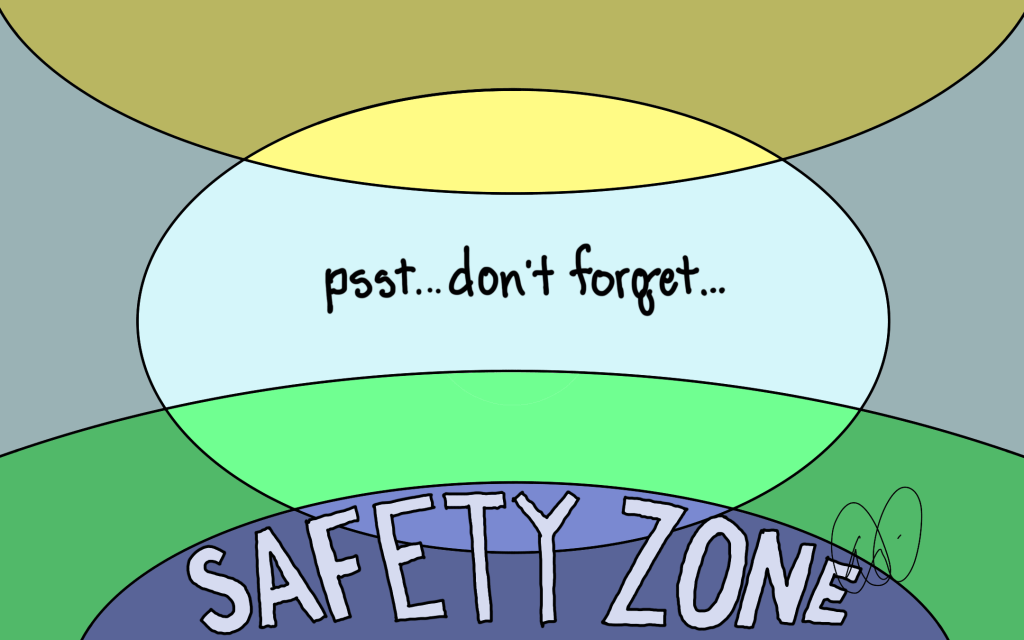
In previous posts, we discussed various components of the human field of vision. We labeled the near field of vision the Comfort Zone and prescribed soft, reflected light. We called the focused, foveal vision the Work Zone and recommended strong, shadow-free illumination from below eye level. Above our heads, our peripheral vision gives us the highly sensitive Glare Zone, which should be free of bright sources pointed at us.
It’s time to add in the last layer, the Safety Zone. Also in our peripheral vision, the Safety Zone wants shielded, glare free light. Because we are quite sensitive to light in our peripheral vision, and therefore in our Safety Zone, we do not need much light to help us navigate. In fact, a few soft pools of light scattered here and there will do a surprisingly impressive job of increasing safety and, just as important, feelings of safety and comfort.
Strategically illuminating the Safety Zone is one move that will push lighting to the next level of comfort and beauty. Yet we rarely give it any thought at all.
In most homes, the approach to lighting is to put a lot of it everywhere, but that is not what our eyes need. When we flood the room with light, we can cause collateral damage while maybe, just maybe, inefficiently and uncomfortably getting the job done.
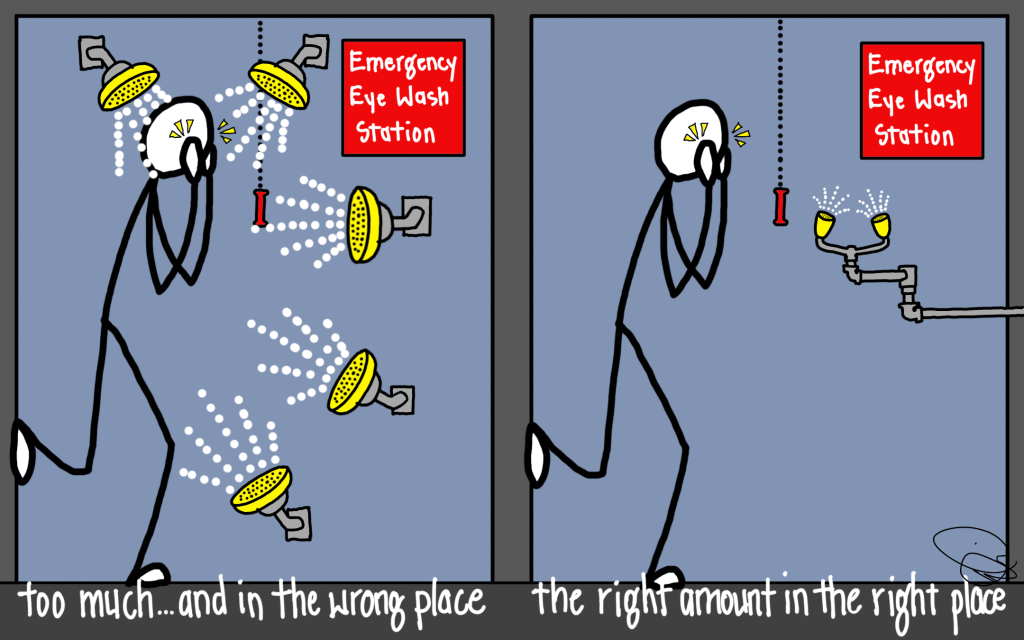
Emergency eye wash stations are a fixture of labs and factories where chemicals might splash past safety goggles and injure the eye. You might be able to build an eye wash station with a bunch of huge showerheads pointing in all directions, and it might wash the chemicals out, but your whole body will be soaked with excess water.
A better choice is to build out a station that delivers just the right amount in just the right place.
A better choice at home is to build out lighting that delivers just the right amount in just the right place.
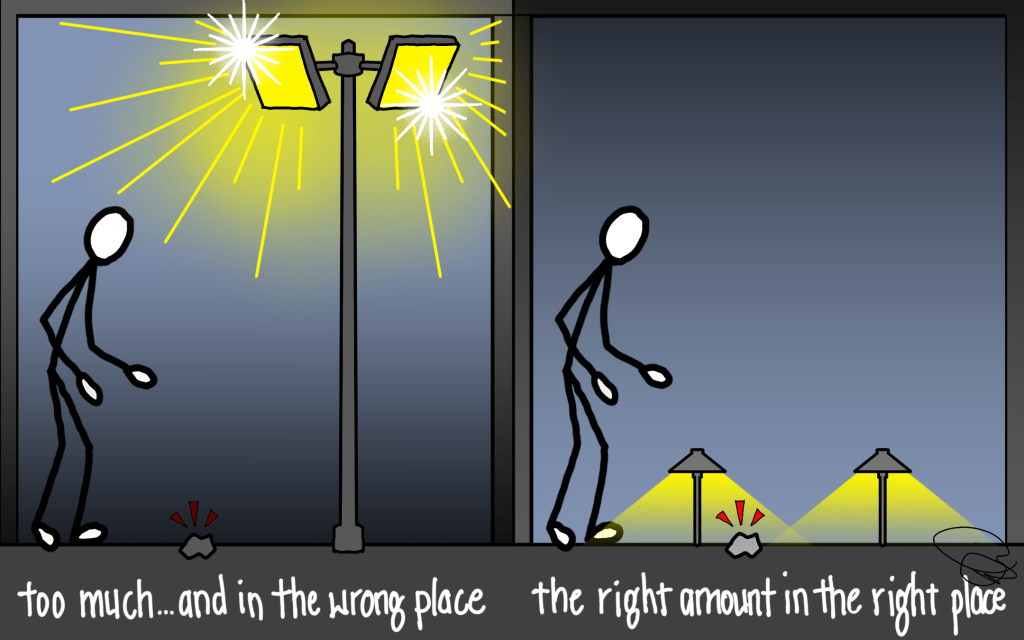
Let’s go outside for a moment. There are many ways to illuminate your back yard. How about a couple of big parking-lot style lights on a pole? That would give you plenty of light, right?
Giant floodlights would give you too much light, introduce disabling glare, and leave the most important areas more difficult to see. Bad lighting can make your life worse.
Stroll through a well-illuminated garden and your experience will be very different. Instead of glare and discomfort, you will move from soft pool of light to soft pool of light and feel comfortable all the while. You’ll have the right amount of light in the right place.
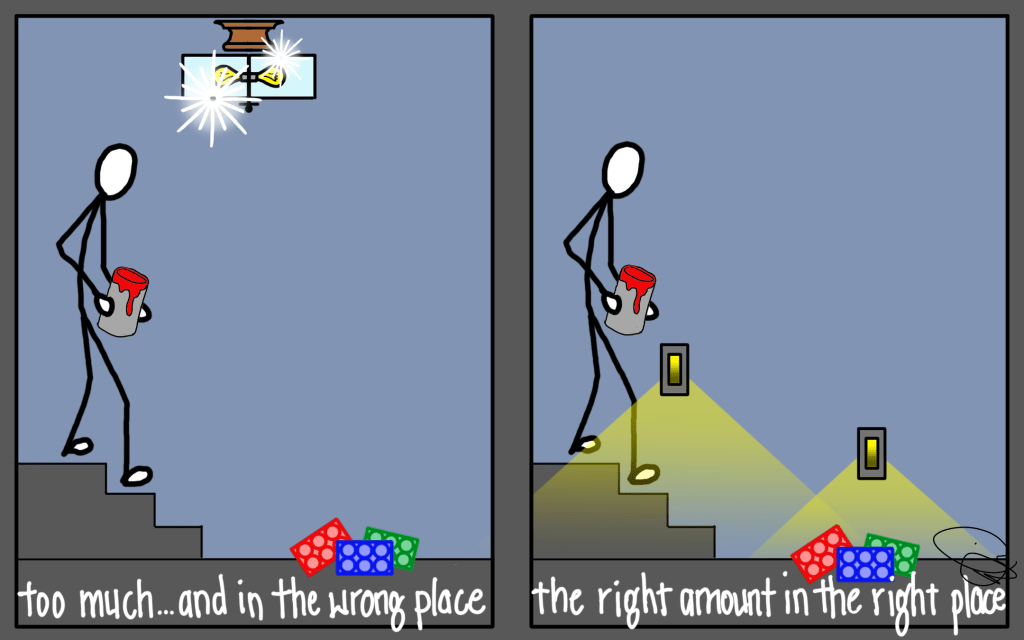
Inside our homes is no different – excessive, bright overhead lighting creates glare with too much light in the wrong place. The iris in our eye may close down a bit to protect us from discomfort, which can actually make it more difficult to see what is on the floor.
What’s the alternative? Like the eye was station or the outdoor path, put the right amount of light in the right place for a safer, more comfortable experience. In the illustration above, step lights recessed into the walls push light downwards, away from the eyes, so that you can really focus on the important stuff like stairs, flooring transitions, and pesky LEGO.
Step lights, which I would rename “indoor path lights” if I could, can be used everywhere. Sure, staircases make sense. But so do long hallways, transitions from one room to a next, anywhere the flooring goes from wood to carpet or stone. Indoor path lights can go anywhere you might trip, fall, step on a toy, or slip on a spill.
Step lights are not the only solution, though they may be the easiest to install. Linear lighting can be carefully concealed in toe kicks, under bar tops, below floating vanities, and even continuously in baseboards to create a soft glow on the floor that improves safety and may even reduce the risk of falls.
It’s easy to overlook the Safety Zone. In most homes, we’ll have so much “extra” light from overhead glare bombs that it would be silly to add in another layer, right? Of course, adding in a layer of indoor path/step lights to a home filled with glare bombs would be a huge improvement because you could leave most of the overhead lighting turned off.
I occasionally talk to people who have recently installed undercabinet lighting, the kind that softly illuminates countertops, for the first time. In most cases, they love it. “It’s the only light I use after dinner” is a common statement. Why do people love it? Because it puts only what you need, where you need it, with minimal glare.
Let’s call indoor path lighting the “undercabinet lighting” of the Safety Zone. Once you have it, you’ll wonder why you waited so long.
When a home is thoughtfully designed for occupant comfort and wellbeing, light in the Safety Zone should be a given.
How could you get pools of soft, glare-free light into your Safety Zone?
 the language of light
Leave a comment