Giving the Simple Gift of Light #11
We spent an entire post exploring how to illuminate the Comfort Zone in dining rooms and discussing the difference between beam angle and field angle. The Comfort Zone, while very important, is not the only place we need to consider when planning out lighting. We also need soft, reflected light in the Glare Zone, strong, shielded light in the Work Zone, and soft pools of light down low in the Safety Zone.
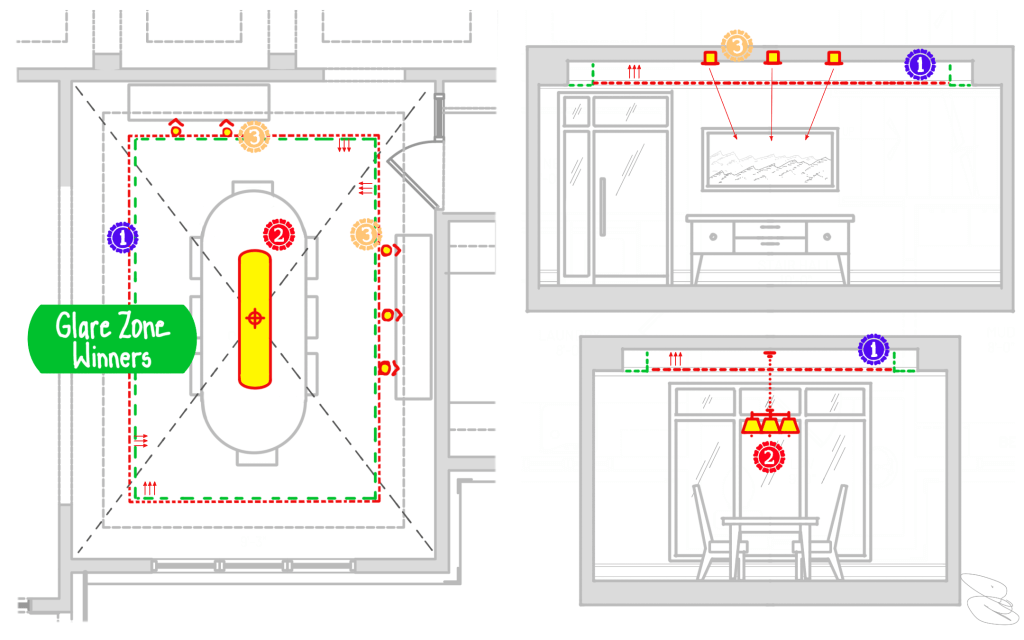
GLARE ZONE: 1ST Place
The Glare Zone, the area of our vision often referred to as peripheral, is highly sensitive to glare and that means we need to fight against bright, direct overhead lighting. A ceiling cove with linear LED strips pointed upwards can fill a room with gentle, soft light that is both comforting and functional, all while adding beauty to the room.
GLARE ZONE: 2nd Place
Most of us will insist on a pendant or chandelier over the dining room table, and for good reason: a good chandelier can light the table and softly illuminate the faces of your dinner guests or family. Sadly, there are far more light fixtures that add glare as well, reducing the positive impact. Picking the right chandelier- one that emits soft diffused light outwards and strong light downwards – can make a big difference in your Glare Zone.
GLARE ZONE: 3rd Place
Bouncing light off walls is another great way to add light to a room without adding glare. Art, cabinetry, stone features, and special wall finishes all make great reflectors, but even a blank wall can serve to diffuse the light and keep it out of your eyes.
A key to a comfortable Glare Zone in a dining room is to make sure you cannot see a bare light bulb. If you can, a part of your eye will be constantly fighting glare.
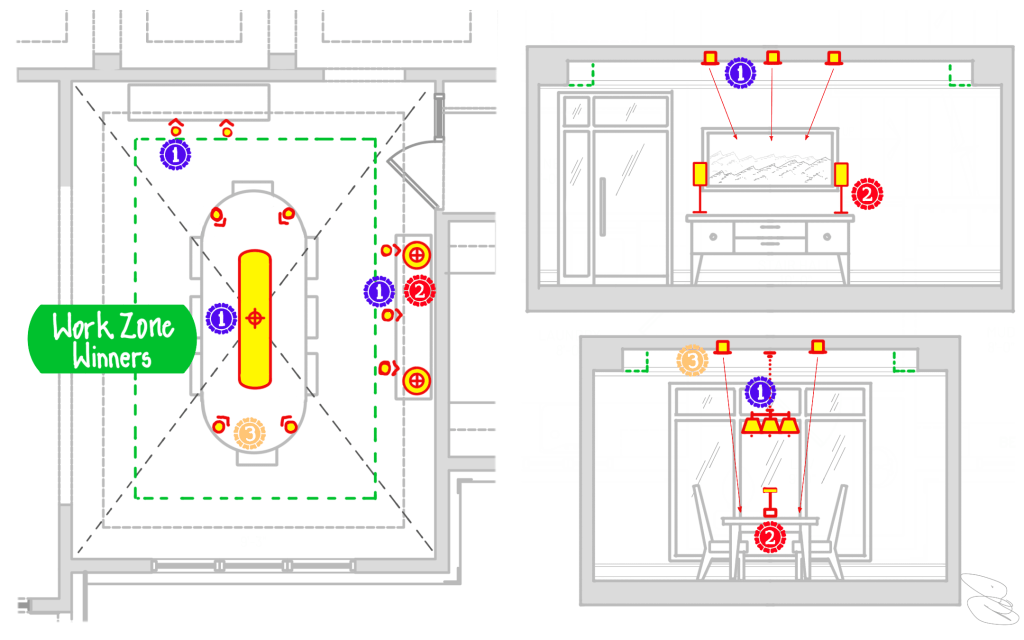
WORK ZONE: 1st Place
The Work Zone is typically where our hands will do tasks; in the dining room, the table and any buffets or sideboards are prime working locations. For the table at the middle of the room, the chandelier is in prime position to provide good, strong light on the dishes, centerpieces, and cutlery, but keep in mind that not all chandeliers deliver good light to the table.
For buffets and sideboards, recessed downlights near each piece of furniture can provide strong light for work while excess light is bounced softly into the room, doubling as a benefit in the Comfort Zone.
WORK ZONE: 2nd Place
Table lamps can be a great way to minimize glare, fill the room with soft, comfortable light, and add strong light to work surfaces. A pair of lamps on a sideboard can satisfy all of those desires, but traditional lamps on the dining table will most likely get in the way. Portable, rechargeable lamps are popular in restaurants for good reason: they deliver light to the table with minimal glare and maximum comfort.
WORK ZONE: 3rd Place
Overhead lighting should be used with care, but sometimes it is the best solution for pushing light to the Work Zone. If a dining room table is too large to be well-lit by the chandelier, or if the chandelier itself is more decorative than functional, recessed downlights located over the shoulders of the table can brighten the Work Zone while minding the glare.
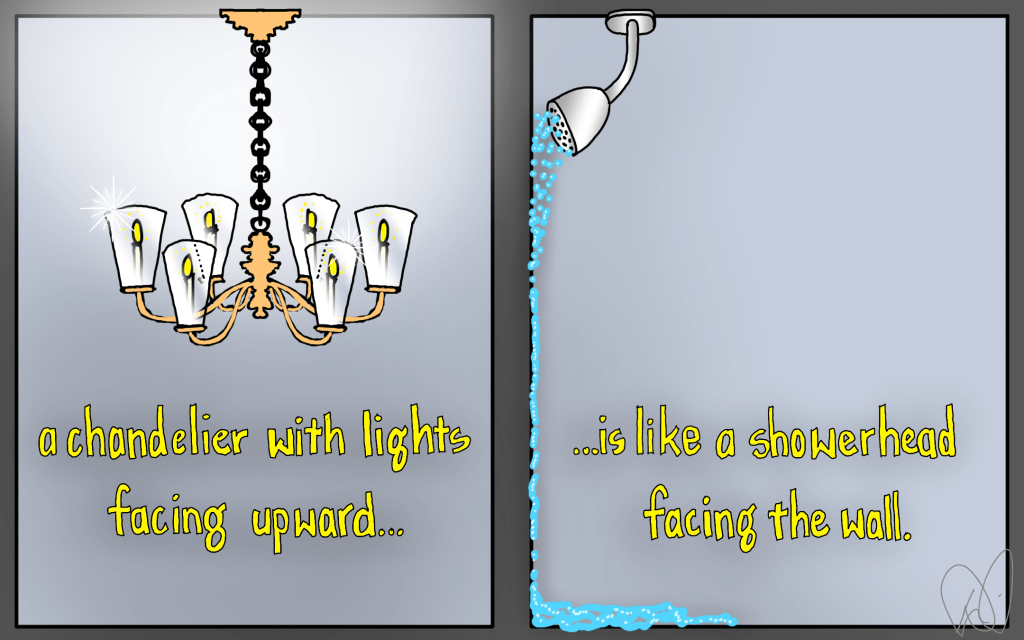
Chandeliers might be worthy of their own post, but for now please just think about what kind of light comes out of the fixture and not just about how it looks when turned off. Lights facing upwards – the only method available when candles provided our light – is a little bit like a showerhead facing the wall. Sure, both will add light or water to the room, but not in a way that is comfortable, functional, or smart.
Instead, look for fixtures that direct strong light downwards and soft light outwards, with a little light toward the ceiling. They can be hard to find, but you will enjoy the benefits every time you sit at the table.
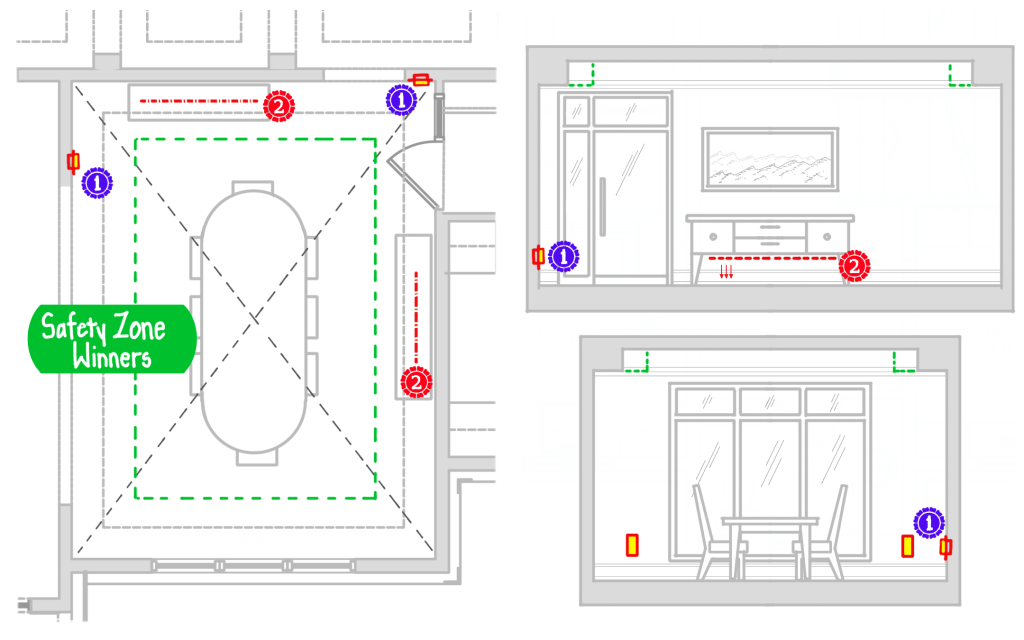
SAFETY ZONE: 1st Place
Indoor path lighting is a simple way to enhance the homeowner’s experience after dark. Wall-mounted step lights, recessed into the walls about 18-24” off the floor, do a great job of creating pools of light throughout a home, and dining rooms are no exception. They are easy to install, easy to control with photocells, occupancy sensors, or timers, and use very little energy. More importantly, they allow people to feel comfortable in the home without turning on a lot of overhead lighting. I typically place these near doorways where they are less likely to be blocked by furniture and so they provide visual waypoints to guide people through the room.
SAFETY ZONE: 2nd Place
Linear light tucked below freestanding sideboards and furniture pieces can cast a soft glow on the floor, adding another layer of comfort to the space when in use. This takes a little more coordination, as lighting must be attached to the furniture and wiring concealed, so I don’t get to do it that often. If you are looking to add a little extra something to the safety zone, this can be fantastic.
There are, of course, many other lighting solutions you can employ in a dining room to help people enjoy their time together. Lighting design is endlessly fascinating, because each home and each resident is different. Built-ins, for example, are another common feature of dining rooms that we did not cover here but that make excellent locations for embedded lighting. I’ll share a few of these edge cases in a subsequent post where we Get Creative. Up next, however, I’m going to work on a post to help you Find the Fixtures.
 the language of light
The more I work with the four zones of light, David, the more I appreciate the simplicity of it, especially for how it shifts the perspective of my clients. They become more open to justifying the cost of strategically adding more light. I know these posts take time to prepare. (I’ve certainly learned that with my YouTube channel!) So, thank you! I’m looking forward to Find the Fixtures!
LikeLike